- Jun 23, 2026
- Ramaharitha Pusarla
Featured Articles
France at the Heart of India’s Tech Pivot
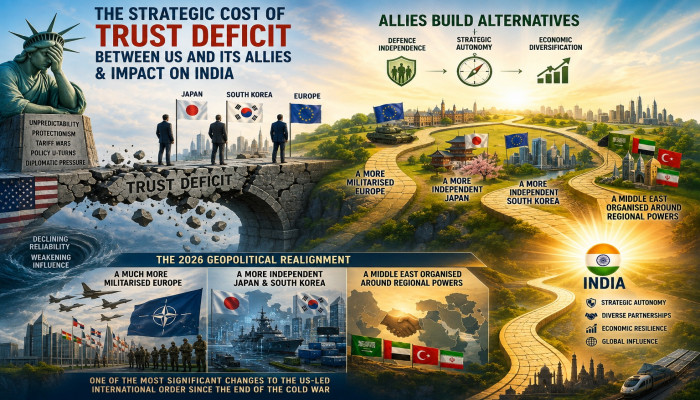
PM Modi’s seventh visit to France, spread across three phases, featured the inauguration of Bharat Innovates 2026 at Nice, a quick trip to Évian-les-Bains for the G7 meetings and a stopover at Paris for the France VivaTech Summit. With geopolitical uncertainties mounting and traditional alliance structures rapidly eroding, the global order is undergoing significant realignment. Openly acknowledging this huge shift, PM Modi, addressing the G7 Summit, declared, “trust is the new global currency” and called for a world that moves “from donor-recepient to partnerships based on trust and equality”. Instructively, while new interest-based coalitions are shaping up, only partnerships anchored in ‘mutual trust and mutual respect’, like Indo-French ties, remained resilient amid global upheavals. India and France elevated ties to “Special Global Strategic Partnership” in February 2026 and jointly inaugurated the India-France Year of Innovation to expand and diversify cooperation in AI, innovation, digital technology, renewable energy, trade and education. The journey of both countries as partners in innovation began with the Paris AI Action Summit, co-hosted by President Macron and PM Modi in 2025. Taking up the baton, India held the subsequent AI Summit edition in New Delhi. Coincidentally, both countries have reviewed ties a day after the US ordered Anthropic to suspend access to foreign countries. Besides, jolting countries from complacency, it has exposed the critical vulnerability of relying on foreign technological infrastructure. The weaponisation of AI has triggered debates of technological sovereignty. It served as a wake-up call for nations to build sovereign infrastructure and develop independent foundational models. To insulate businesses from such shocks, enterprises are now moving away from single-model dependencies to multi-model architectures. To safeguard technological sovereignty from the overbearing conduct of the superpowers, Middle powers are now deepening issue-based coalitions. The coming together of India and France, both Middle Powers, is also rooted in their quest to unlock innovation potential and build a future-oriented innovation partnership. Positioning innovation as an important pillar of partnership with the India-France Innovation Roadmap 2030, countries attest to its role in economic resilience, sustainable development, strategic autonomy, and technological and industrial sovereignty. Firming up the innovation partnership, France hosted the first foreign edition of Bharat Innovates, a flagship initiative showcasing India’s deep-tech startups. This platform aims to become a launchpad for India’s technological ambitions. Jointly inaugurated by PM Modi and President Macron, 120 Indian startups and 500 global investors, venture capitalists, and business leaders participated in the event. Technology remained one of the focus aspects of PM Modi’s week-long visit to France and Slovakia, where he eloquently presented India’s human-centric and inclusive AI vision. To mobilise tech cooperation and investments, PM Modi attended the 10th edition of VivaTech in Paris, where India was the AI country of focus. At the event, PM Modi met CEOs of Mistral AI, Saint Gobain, Alstom and the CMA CGM Group and briefed them about India’s aspirations of becoming an innovation economy. Addressing the event, PM Modi hard sold India’s digital transformation that has phenomenally revolutionised Indian lives by delivering prosperity at the grassroots levels. Attended by tech giants, innovators, business leaders and 15,000 startups drawn from 165 countries, the Paris edition also had an Indian Pavilion. Over 80 deep-tech Indian startups showcased their innovations at the event. Taking a serious note of the US government’s directive to Anthropic to suspend access to Fable 5 and Mythos 5 models for foreign nationals, European companies like Siemens, Renault, Chaps Vision announced their plans to diversify their AI providers at the event. Rearing to become an innovation economy, India is investing heavily to build a technology ecosystem. In the past decades, India has launched Startup India, Digital India Programme (2015), National Supercomputing Mission (2015), Semicon India Programme (2021), Design Linked Incentive Scheme (DLI, 2021), National Quantum Mission (2023), National Blockchain Framework (2021), Chips to Startup Programme (C2S, 2022), and the Bharat6G Alliance (B6GA, 2023) to harness the innovative potential of Indian youth. Sustained investments and strong policy support helped India rise to the 38th position in the Global Innovation Index in 2025 from the 81st position in 2015. India ranks first among lower-middle-income countries in innovation. But India’s ranking woefully falls short of its ambitious vision of a $10 trillion economy by 2034-25. Despite strong digital infrastructure, a huge talent pool, government initiatives and massive AI penetration, India fares rather poorly in terms of AI infrastructure and innovation. Its R&D investment (0.65 per cent of GDP) is way behind the global average (2-3 per cent). Stymied by brain drain, India suffers from an innovation output and input balance. France has a robust research infrastructure and venture ecosystem. India has huge, unexplored, organically growing tech talent capable of providing cost-effective deep-tech solutions. Integrating these complementary strengths, countries can address the 21st-century global challenges. To concretise this synergy, countries have affirmed to adopt the India-France Innovation Roadmap 2030, which resonates with India’s 2047 Viksit Bharat and France 2030, an innovation flagship initiative of the French government. Working together for the shared vision of combating climate change, India and France instituted the International Solar Alliance (ISA) in 2015, a beacon of sustainable development with over 120 signatory nations. A decade later, on the foundation of shared values and vision, countries signed a declaration on Artificial Intelligence. In the recent past, countries have launched initiatives ranging from security to sustainability to provide solutions to global issues. Giving a huge fillip to the India-France Innovation ecosystem, countries are promoting academic collaboration, scientific cooperation, and strengthening frameworks for mutual recognition of academic qualifications. France has set a talent mobility target of 30,000 Indian students by 2030. To facilitate academic mobility, it has instituted welcoming legal pathways. Through InnoXchange Bridge, countries are developing a dedicated entrepreneurship corridor for reciprocal access to research organisations, technology platforms and innovation clusters, startup ecosystems. In addition to the India-France Innovation Network (IFIN), countries are strengthening partnerships between private space ecosystems and consent-based data sharing on global health challenges. Countries have signed 19 MoUs to seamlessly integrate the research ecosystems of both countries through collaborations between the elite research and academic institutions under the broad framework of Innovation Roadmap 2030. Reviewing the bilateral relations spanning diverse sectors, countries exchanged MoUs on the establishment of the Centre of Excellence in skilling in Aeronautics at IIT Kanpur, expanding the spread of UPI in France, the establishment of a high-level mechanism to double bilateral trade in the next five years, cooperation in high-speed rail development and human space exploration. Along with the traditional sectors like trade, textiles and engineering, countries are also intensifying cooperation in defence, nuclear energy and space. Tighter US immigration policies, persistent H1B visa issues, mounting green card backlogs and high visa denials Indian students have widened faultlines and strained longstanding tech collaboration frameworks. Additionally, the strategic tech ‘kill button’ wielded by Trump has prompted India to actively deepen ties with reliable and trusted partners. As a result, the Indian tech ecosystem is accelerating its drift towards Europe. India has signalled its commitment to open up pathways for trade, technology and tourism by signing the FTA with the EU. Among European countries, India’s relationship with France is one of its most enduring bilateral partnerships. As a resident power of Indo-Pacific, France occupies a unique place in India’s strategic calculus, making it a significant player in India’s geopolitical realm. France is emerging as a vital connecting point between the European and Indian innovation, industrial and tech ecosystems. India’s growing engagement with France is not a mere economic choice but a carefully calibrated strategic pivot. References https://www.mea.gov.in/bilateral-documents?dtl/41306/IndiaFrance_Innovation_Roadmap_2030_June_14_2026 https://www.mea.gov.in/bilateral-documents?dtl/41305/List_of_outcomes_Visit_of_the_Prime_Minister_to_France https://www.mea.gov.in/media-briefings?dtl/41335/Transcript_of_Special_Briefing_on_the_visit_of_Prime_Minister_to_Paris_France_June_19_2026 https://www.mea.gov.in/media-briefings?dtl/41307/Transcript_of_Special_Briefing_by_MEA_on_the_visit_of_Prime_Minister_to_Nice_France_June_14_2026 https://www.mea.gov.in/speeches-statements?dtl/41331/Prime_Ministers_address_during_VivaTech_2026_Paris_June_18_2026 https://www.mea.gov.in/speeches-statements?dtl/41302/English_Translation_of_Prime_Ministers_address_at_the_Bharat_Innovates_event_June_14_2026- Jun 23, 2026
- Swami Pranaka